
The employees who are getting the most out of AI — the ones driving measurable productivity gains — are also the most afraid of what it means for their futures. They are discovering that the better they use the tool, the faster they might automate themselves out of a role.
That paradox sits at the heart of what I want to explore here. Not as an economist or a technologist, but as an ORSC-trained systems coach who has spent years working in a global organisation with teams and leadership teams at the exact moment things stopped working, and the official strategy and the lived reality of the organisation diverged.
That divergence is happening right now, at scale, in almost every enterprise that has deployed generative AI. The leaders best placed to address it are the ones willing to name what is actually going on in the system. CEOs, transformation leaders, and anyone responsible for how organisations move through change. This article is written for them.
The Contemporary Paradox – What Is Actually Happening
Imagine a large financial services firm. Last year, the board approved a multi-million-dollar rollout of enterprise generative AI: thousands of seats, embedded across every software suite. The business case was airtight. Automate 30% of routine analytical work, unlock strategic capacity, accelerate output. The technical deployment was flawless.
Six months later, the CFO is staring at a flat productivity curve and a soaring cloud compute bill.
What went wrong? The organisation poured capital into infrastructure and starved the human development required to make it useful. Employees were not given a roadmap. They were given a login.
The result: senior analysts trapped in prompt-wrestling, spending hours auditing, correcting, and second-guessing AI outputs. Mid-level managers are drowning in AI-generated text that everyone is producing, and no one has time to read. The organisation upgraded the velocity of its tools without understanding the organisational dynamic, involving their people and upgrading their capacity. They are accelerating. They have no idea where they are going.
The System Is Terrified
As a leader, you may be puzzled by why employees are not embracing these million-dollar tools. From a systems perspective, the answer is not mysterious. The system is operating in survival mode.
We cannot talk about an AI skills gap without first naming the emotional reality underneath it. The data is stark. According to the ADP Research Institute, fewer than 1 in 4 workers globally feel confident their job is safe from elimination. A Resume Now report found that 51% of workers are actively worried about losing their jobs to AI, and 60% believe AI will destroy more jobs than it creates. And then there is the paradox I opened with: recent research reveals that the employees most exposed to AI, achieving the highest individual productivity gains, also report the highest levels of anxiety about long-term displacement.
When I look at these numbers through a coaching lens, I do not see statistics. I see a workforce in a state of chronic, low-grade trauma.
In systemic coaching, fear is one of the most powerful forces in any human system. When safety, status, or livelihood feels threatened, the nervous system of an organisation shifts out of creativity and collaboration and directly into freeze, fight, or flight. Employees mask their anxiety through passive resistance. They hide the ways they use AI. They quietly disengage. Gallup data shows that only 32% of employees are currently actively engaged, with many describing their workplaces as increasingly isolated and impersonal.
You cannot build a culture of innovation on a foundation of existential dread.
When corporations prioritise technology reinvestment over people investment, they are not just leaving a skills gap. They are actively dismantling the psychological safety that any learning system requires to function.

The Scale of the Disconnect
The macroeconomic picture makes this tension visible. Global AI spending is projected to hit $2.5 trillion, a 44% year-over-year increase. At the same time, Gartner’s research places AI firmly in what they call the Trough of Disillusionment — the predictable phase where early excitement gives way to frustration, returns disappoint, and organisations question whether the investment was worth it. Randstad Digital reports that 60% of enterprise leaders acknowledge a significant AI skills gap. Yet over 90% of companies continue scaling AI investments, building platforms faster than employees can actually learn to use them.
The investment thesis is sound. The systemic design is not. And that gap between the pace of the technology and the capacity of the people is where the value is haemorrhaging.
Seeing AI as Part of the System — The Paradigm Shift
To understand why a trillion-dollar investment yields a flat productivity curve, we have to stop treating AI as a sophisticated version of a spreadsheet. A spreadsheet has no agency. It does not adapt, change its behaviour, trigger existential anxiety, or alter the relational dynamics of a team.
AI does all of these things.
In ORSC (Organisational and Relationship Systems Coaching), we work with teams and organisations not as collections of individuals, but as single, living entities: Relationship Systems. Every system has its own intelligence, its own patterns, its own unexpressed dynamics. When you introduce generative AI into that system, you are not making a software update. You are introducing a new force into the social fabric of the organisation. And like any new force in a system, it changes everything.
The Ghost in the Room and the Disruption It Is Becoming
In systems work, we speak of Ghost Roles, forces that are present and actively shaping a system, but that no one names, discusses, or formally acknowledges. This can be a founder who left years ago but whose shadow still governs every decision. It can be a trauma the team experienced that no one talks about, but everyone navigates around. Ghost Roles have enormous power precisely because they operate below the level of conscious awareness.
AI entered most organisations exactly as this kind of ghost.
Employees were quietly crafting prompts, generating drafts, and checking their own thinking, all without telling their managers, flagging it in performance reviews, or integrating it into any formal workflow. It was present everywhere and acknowledged nowhere. The system was being shaped by a force it had not yet agreed to see.
But AI is not staying in the ghost position. It is too loud, too visible, too structurally embedded for that. What began as a ghost is becoming something closer to a Disruptive Role, a force that has moved from the margins of the system to its centre, demanding that everything reorganise around it. Budgets, job descriptions, team structures, and success metrics. All of it is being pulled into AI’s gravitational field, whether the organisation intended that or not.
For CEOs and transformation leaders, this transition from ghost to disruptor is the moment of greatest systemic risk. A ghost can be named and integrated. A disruptor, if it arrives before the system has the capacity to metabolise it, creates fragmentation. That is what we are seeing in the flat productivity curves, the disengagement data, and the prompt-wrestling analysts. The system has not yet caught up with the role that has arrived in it.

The Loss of Informal Learning: When Deep Democracy Goes Silent
In systems coaching, we rely on the principle of Deep Democracy. The idea that every voice, every subtle channel of information, must be accessed and heard to understand the whole. For decades, organisations transmitted their knowledge, culture, and institutional memory through informal channels, leaning across a desk to ask a senior colleague a question, overhearing a mentor handle a difficult client, and debriefing by the coffee machine.
When an anxious employee turns exclusively to an AI interface, partly for convenience, partly to hide their fear of looking incompetent, that social transmission breaks down. The AI answers the prompt instantly. But the team loses its connective tissue. The quieter voices in the system go unheard, because the loop has closed around a single, confident, non-human respondent.
We are trading long-term cultural resilience and mentorship depth for short-term transactional speed. The organisation becomes faster and shallower at the same time.
The Illusion of Competence: When Muscle Atrophies
This is the dynamic that concerns me most as a coach. Our competency frameworks, succession pipelines, and development pathways were built on the assumption that capability is demonstrated and built through the work itself.
AI shatters that assumption. A junior analyst who uses a sophisticated prompt to produce a brilliant strategic deck in five minutes is not the same as a junior analyst who built that deck through research, judgment, and iteration. The output looks identical. The underlying capability is not. If that person cannot explain how the AI arrived at its conclusions, cannot critique the context, cannot catch what the model got subtly wrong, they have borrowed competence, not built it.
The technology is sprinting forward. The human capacity underneath it is quietly atrophying. This is the hidden liability in your AI investment: an organisation that looks more capable than it is.
How Organizations Can Genuinely Thrive — The Way Forward
The organisations that will come out of this trough ahead are not the ones that bought the most AI licenses. They are the ones whose leaders treated AI deployment as a whole-system design challenge, where the human dimension was a co-equal part of the strategy from day one, not an afterthought to it.
Here is what that looks like in practice.
Joint Optimisation: You Cannot Fund One Half of a System
In systems work, we know that a system cannot remain healthy when one part is hyper-resourced and another is starved. Right now, organisations are pouring capital into the technical layer while treating human adaptability as a secondary budget line, a soft cost to be negotiated down when margins tighten.
The reframe is this: for every dollar budgeted for AI compute, enterprise licensing, and infrastructure, a dedicated and non-negotiable percentage must be hardcoded into human development, psychological safety, and AI-native learning. Not as a reactive training program bolted on after deployment. As a co-equal design requirement from the beginning.
For CEOs, that means your People and Culture lead is a strategic co-author of the AI investment, not a downstream executor of it. The human system is not downstream of the technology investment. It is the investment.
Working With the Original Myth: The Change Curve Has a Story Underneath It
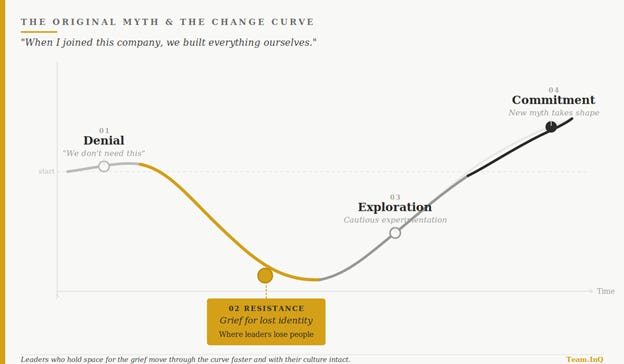
Every organisation carries what systems coaches call an Original Myth, the foundational narrative of how things came to be and what made them work. You hear it in phrases like: when I joined this company, we knew every client personally. When this team started, we built everything ourselves. Before the merger, decisions happened in a room, between people who trusted each other.
These are not nostalgic complaints. They are the system speaking about its identity, about what it believes made it valuable, competent, and coherent. When AI arrives and begins to alter those fundamental ways of working, it does not just change workflows. It threatens the myth. The leader’s first job, before any change management framework or communication plan, is to listen. To ask what this system believed made it great. And to make sure that answer is honoured in whatever comes next.
The change curve, denial, resistance, exploration, commitment, is well known to every transformation leader. What is less often acknowledged is that the resistance phase is rarely just about the new tool. It is about grief. Grief for a version of professional identity that the new reality seems to make obsolete. The analyst who spent fifteen years mastering the craft of financial modelling does not just fear losing their job. They fear losing the thing that made them good at it.
Leaders who name this explicitly, who hold space for the grief as a legitimate systemic response rather than a productivity obstacle to be managed away, move through the change curve faster, and with their culture intact. The invitation is not to abandon the original myth, but to help the system find what is still true inside it, and carry that forward into the new context.
From Substitution to Augmentation: Honouring the Human Asset
When AI is deployed primarily as a headcount reduction mechanism, organisations trigger the precise survival responses that make the technology fail. Employees who believe their job is to be automated do not engage openly. They protect themselves.
The strategic shift is to use AI to absorb predictable, high-volume transactional work and, simultaneously, explicitly redesign human roles around the cognitive surplus that creates. The analyst’s job is no longer to produce the first draft. It is to govern, contextualise, and critique the AI’s output. That is a different job. It requires different development. It requires a different conversation about value.
Leaders who articulate that new contract clearly, who help employees understand what they are being freed for, not just what they are being replaced in, are the ones who will preserve engagement through this transition.
Dream With the Machine: The Three Levels Where Humans Still Lead
In systems coaching, we work with three levels of reality that coexist in any human experience. There is the Consensus Reality: the measurable, verifiable, agreed-upon world of facts, outputs, deliverables, and KPIs. There is the Dreaming level: the world of imagination, felt sense, and emergent possibility that has not yet taken form. And beneath both, there is the Essence level: the deepest current of identity and purpose that gives meaning to everything above it.
AI operates almost entirely at the Consensus level. It is extraordinarily good at synthesising what is known, optimising what is measurable, and producing outputs that meet defined criteria. It can simulate the Dreaming level, generating novel combinations, unexpected connections, and creative variations, but it cannot originate from it. It has no felt sense of what matters. It has no stake in the outcome.
This is where human beings are irreplaceable and where organisations need to be actively investing. The capacity to sit with ambiguity and let a genuinely new idea emerge. The ability to sense what a client needs before they can articulate it. The courage to challenge a direction that looks right on paper but feels wrong in the room. These are Dreaming-level and Essence-level capacities. They cannot be prompted into existence.
The practical invitation for any leader serious about this transition is this: stop treating AI as the imagination and humans as the executors. Reverse it. Let AI handle the execution layer and design your culture, your development programs, and your strategic rhythms to pull human beings toward the Dreaming level. Toward the questions that have not been asked yet. Toward the futures that cannot be extrapolated from the data alone.

The organizations that will define the next decade are not the ones that automated the most. They are the ones that learned to dream alongside the machine and knew which parts of that dream only humans could hold.
The Choice in Front of Us
We are at a genuine inflection point. Organisations can continue accelerating without direction, pouring trillions into tools while leaving a frightened, stagnating workforce in their wake. The result is not transformation. It is technical debt at scale, sitting on top of a demoralised human system.
Or leaders can choose to look at their organisations as what they actually are: living, relational systems, where the human layer is not a support function for the technology, but the entire point of it.
AI arrived in most organisations as a ghost, unnamed, unacknowledged, quietly reshaping everything. It is now demanding to be seen. The question is not whether your organisation will respond to that demand. It is whether you, as a leader, will get ahead of it or be pulled along by it.
Matching technical velocity with human capacity is not a soft ambition. It is the most important strategic challenge any leader, CEO, transformation lead, or people executive will face in the decade ahead. And unlike the technology itself, it cannot be deployed. It has to be built, person by person, team by team, conversation by conversation.
Written from the perspective of an ORSC-certified systems coach and leadership development practitioner.
