
Part 1: With our backs against the wall
Seeing the world through a systems lens is both a blessing and a curse.
It helps to recognise parallel patterns and anticipate moves. And it is hard having to watch how leaders – both in politics and business – apply trusted but rusty tools of the past to unprecedented challenges.
The world has become increasingly complex during our lifetime. It started with a globalisation of trade, finance and the workforce. We are now facing paradoxical problems such as talent shortages alongside anticipated redundancies driven by rapid advances in AI.
In the social sphere, people are increasingly stepping outside established norms and identities. In what we call Western societies, citizens clash over gender identity, equality and roles. While many celebrate an increase in liberty and quality of life, others mourn the perceived erosion of orientation held up by rigid identities. Seeing their paradigm threatened, both sides react defensively.
Complexity and unpredictability in business and society feed fear, and being afraid usually causes us to take a step back, to back up against the wall in search of protection. It stalls any forward momentum that isn’t aggressive or a fight response. When fear reigns, we react rather than respond with clarity and intent.
Leaders under pressure reach for the tools that got them here, but in doing so, fail their people in helping them navigate and pioneer an unknown future.
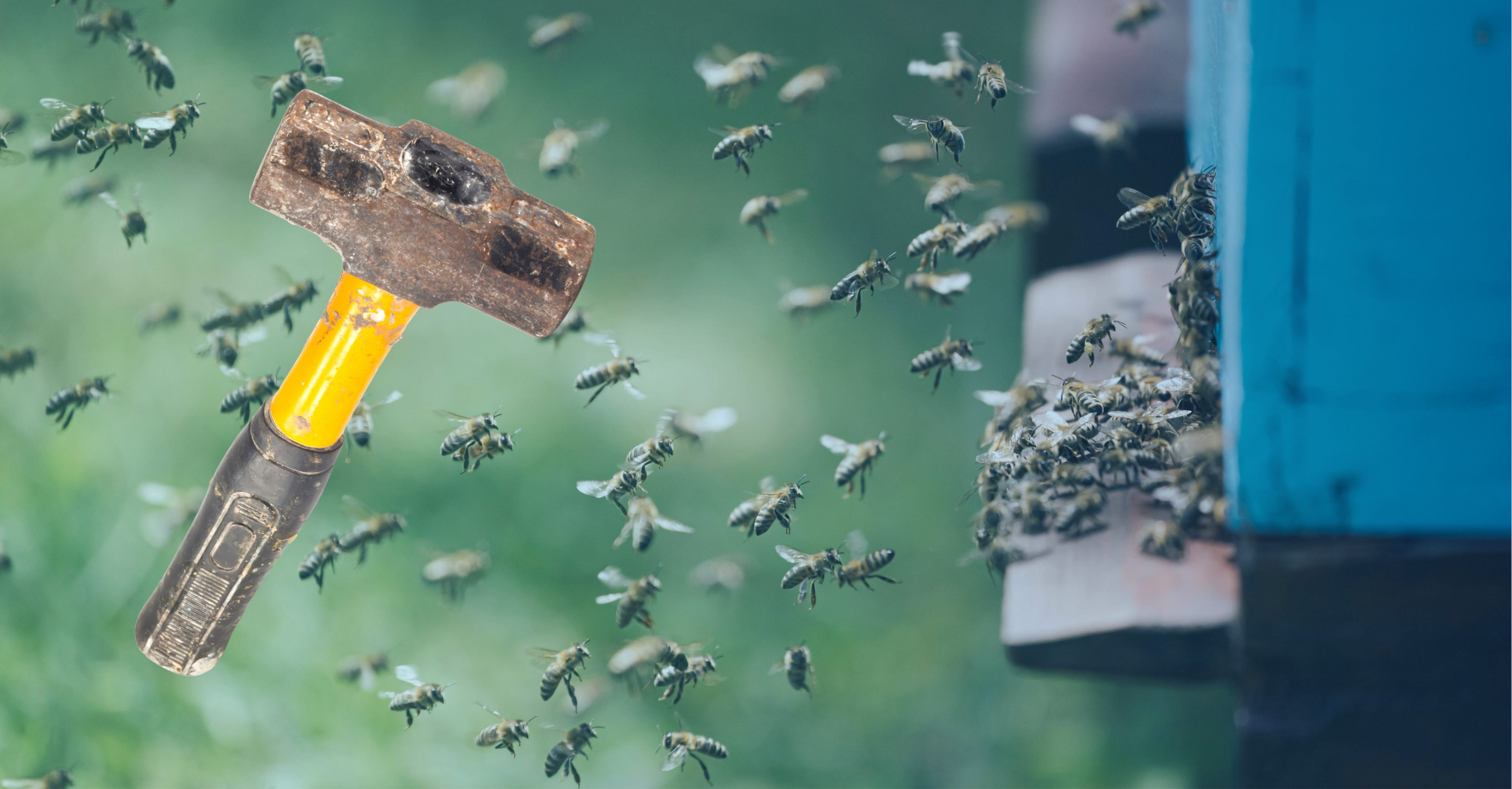
Or put metaphorically: we are chasing a myriad of moving targets with heavy machinery. Sledgehammers are effective when blunt force is needed, but less so in intricate, complex environments. Great for tearing down walls. Useless for growing a living system like a garden.
It is no coincidence that Frederic Laloux, in his book “Reinventing Organisations,” compared the most evolved form of collaboration with an intelligent, self-organising eco-system.
Hierarchical leadership has its place in certain situations. Still, if the environment is too complex for an elite few to handle and calls for innovative solutions, it calls for the intelligence of many to swarm and solve.
Today, in response to pressure in the business and political spheres, many companies and leaders are seemingly relying again on old instruments rather than inventing new ones. Instead of evolving work practices, it feels like a renaissance of the past.
But here’s the thing: humans have always adapted their toolset to new circumstances. It is what makes us successful as a species and is crucial for our survival. The abacus is great, supercomputers calculate large amounts of data in fractions of its time. We are no longer lifting iron shields against missiles; we invented invisible shields in the sky.
Tools like control and protectionism once worked in simple business environments, but now limit the intelligence and leverage to solve the problems businesses and humanity as a whole face in the future.
Between stimulus and response, there is a pause, and in this pause is the freedom to respond, said Viktor Frankl. I would add: the freedom to sense, reflect, and respond with the combined power of human, artificial, and system intelligence.
This intelligence is the largest capital companies have in an unstable, unpredictable and complex world. Harnessing this intelligence, thinking holistically and co-creating at the speed of true collaboration will be the key to unlocking the next level of work.
Innovation through creative leadership and collaboration requires two major ingredients that seem counterintuitive in our technocentric world: courage and faith.
Courage to pause, sense, and decide with a view to the whole and not just the loud voices of its parts.
Faith to trust the intelligence in your team and the wider system you operate in. And in our ability to discover and invent the tools that are the right ones to meet the challenges of our time.
This is the first of three reflections on what it takes to lead well in a world that keeps changing the rules. Next: what happens in the pause — and why daring to lean forward is harder than it sounds.
The shift from reactive to creative leadership — and the courage it requires — is exactly what we explore in TeamSense, our new workshop for leaders navigating complexity. If this resonates with the challenges.